Part of Twin Cities Then & Now, a series about the history behind Minneapolis and St. Paul neighborhoods and how it still shapes them today. Watch the episode below, or read the full story.
Quick facts: Twin Cities streetcars
- Who built it: Twin City Rapid Transit Company, led by Minneapolis lawyer and land investor Thomas Lowry.
- How big it got: more than 520 miles of track and around a thousand streetcars at its peak in the early 1920s, reaching from Stillwater to Lake Minnetonka.
- Peak ridership: a record 238 million rides in 1920.
- When it ended: the last streetcar made its final run on June 19, 1954, four years ahead of the original plan to switch to buses.
- What’s left: the business districts and neighborhoods that grew up along the lines, including Linden Hills, Lake & Hennepin, 50th & Bryant and University & Snelling.
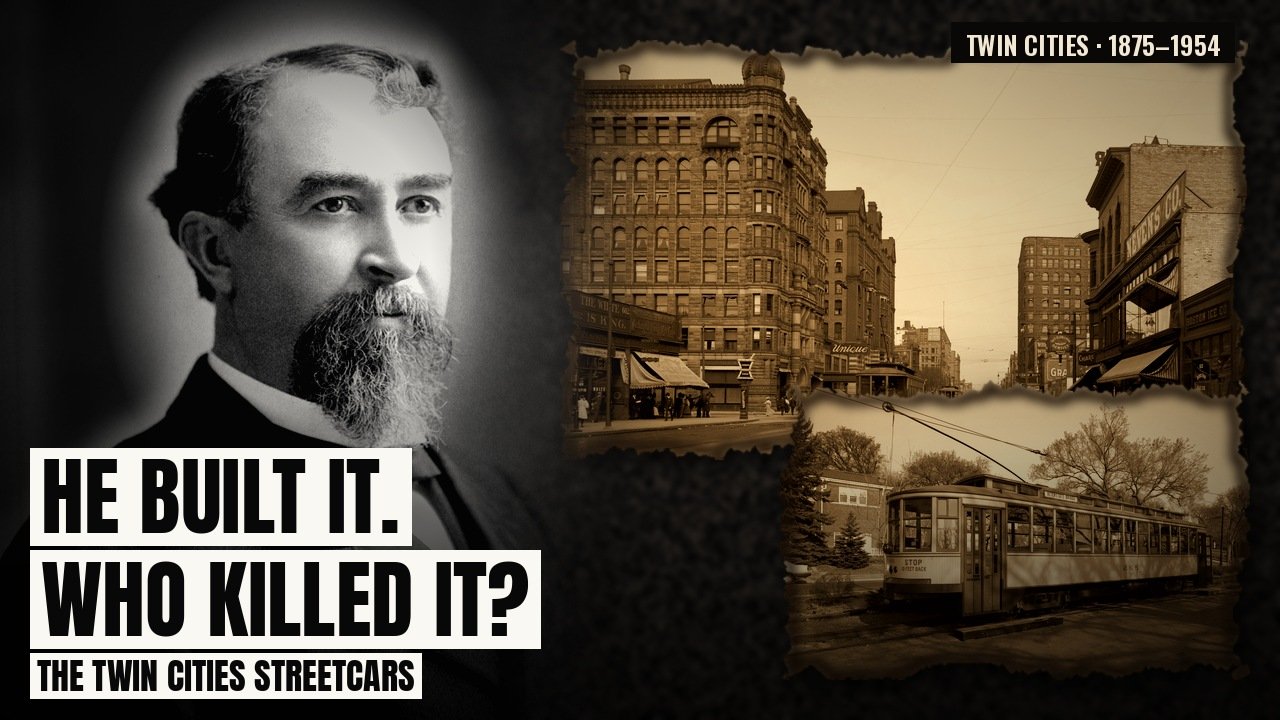
Thomas Lowry: the land investor who built the lines
Thomas Lowry came to Minneapolis in 1867 as a young lawyer and started buying land. By one account, during the 1870s more than a third of the property that is now Minneapolis passed through his hands. In 1875 a horse-drawn streetcar line opened between downtown and the University of Minnesota, and Lowry soon took control of the company and later the St. Paul company too.
The first electric streetcar line opened in Minneapolis in 1889, and by 1892 every horse line in both cities had been converted. Lowry pushed to extend the rails into land that hadn’t been developed yet, and much of that land was his. Build the line, and the lots become valuable.
How streetcars shaped Twin Cities neighborhoods
As one local historian put it, where streetcar track was laid, neighborhoods and businesses would follow. The Como–Harriet line opened in 1898, running 17 miles from Como Park in St. Paul to Lake Harriet in Minneapolis, with a station built just for people visiting the lake and its pavilion.
Small business districts grew up at the major stops: Lake & Hennepin, University & Snelling, 50th & Bryant and 54th & Penn. The typical building was a two-story corner building with shops on the ground floor and apartments upstairs. Linden Hills still has one of the best collections of these streetcar-era buildings.
The lines reached the suburbs too. In 1906 a line opened west to Hopkins and split toward Deephaven and toward Excelsior and Tonka Bay. At Lake Minnetonka, riders could step off the streetcar onto one of the company’s express boats. To the east, cars ran to Stillwater and to White Bear Lake, where the company opened the Wildwood amusement park.
Why the Twin Cities lost its streetcars
Cars came first. Through the 1920s, better roads and more automobiles cut into ridership. Most of the Lake Minnetonka express boats were scuttled in 1926, and the Lake Minnetonka line closed in 1932. Gas and tire rationing during World War II brought riders back for a while, and the company bought modern streamlined cars, but ridership fell again after the war.
Then came a change in ownership. In the late 1940s, New York investor Charles Green bought a large block of stock, frustrated that the company reinvested its profits rather than paying them out. He took control in 1949, cut hundreds of jobs, stopped maintaining the streetcars and announced a full switch to buses by 1958. Green sold his shares in 1950, and local lawyer Fred Ossanna took over in 1951.
Ossanna sped up the conversion. General Motors financed 525 new buses, buses began replacing streetcars in St. Paul in 1952, and the last streetcar ran on June 19, 1954. The modern streetcars were sold to Mexico City; Newark, New Jersey; and Shaker Heights, Ohio. Most of the older cars were burned to recover their scrap metal.
Federal prosecutors later charged that company insiders sold off assets such as scrap and land at steep discounts in exchange for kickbacks. In 1960, Ossanna was convicted of federal fraud charges. He maintained his innocence.
So was it a conspiracy?
Not exactly. Local transit historians say the bigger force was simpler: people wanted cars. Car ownership had already drained the streetcar’s profits, and many of the cars were wearing out. One historian estimated the streetcars would probably have disappeared by around 1960 anyway. What the insiders changed was the speed, and crimes were committed along the way.
What it means for Twin Cities homes today
The streetcars are gone, but the map they drew is still here. Many of the neighborhoods buyers love for their walkable corners, local shops and older homes grew up along streetcar lines more than a hundred years ago. And the region is building rail again: the Blue Line opened in 2004, and in 2014 the Green Line opened along University Avenue, the same corridor where one of the first electric lines connected Minneapolis and St. Paul in 1890.
If you own a home in a former streetcar neighborhood, that history is part of its story and part of what buyers are paying for: walkability, nearby shops and established streets. When it’s time to price your home, those neighborhood features matter as much as the house itself.
Frequently asked questions
When did the Twin Cities streetcars stop running?
The last Twin Cities streetcar made its final run on June 19, 1954, after Twin City Rapid Transit converted the system to buses.
How big was the Twin Cities streetcar system?
At its peak in the early 1920s, the system had more than 520 miles of track and around a thousand streetcars, and it carried a record 238 million rides in 1920.
Which Minneapolis neighborhoods were shaped by streetcars?
Business districts grew up at major stops such as Lake & Hennepin, 50th & Bryant, 54th & Penn and Linden Hills in Minneapolis, and University & Snelling in St. Paul. Many streetcar-era corner buildings are still standing.
Can you still ride a Twin Cities streetcar?
Yes. The Minnesota Streetcar Museum runs restored streetcars on a section of the original Como–Harriet line between Lake Harriet and Bde Maka Ska, with a recreated Linden Hills station. Check the museum’s current schedule before you go.
Thinking about buying or selling in the Twin Cities?
I’m Jose Ramirez, a REALTOR® with Keller Williams Realty Integrity Lakes, and I’ve helped Twin Cities families buy and sell homes for more than 11 years. If you’re curious what your home is worth today, or you want a step-by-step plan for selling, these free resources are a good place to start. Se habla español.
Sources
- MNopedia (Minnesota Historical Society): Twin City Rapid Transit Company and Electric Streetcars
- Star Tribune: the streetcars, the buses and Fred Ossanna
- Star Tribune, Curious Minnesota: Where did suburban streetcar lines run?
- Star Tribune: Twin Cities work/live buildings have roots in the streetcar era
- Minnesota Historian: Take a Ride Aboard the Trolleys of Southwest Minneapolis (2022)
- Wikipedia: Twin City Rapid Transit Company; Thomas Lowry; Fred Ossanna
Historic images: Library of Congress, Prints & Photographs Division (public domain); portrait of Thomas Lowry: Hennepin County Library (public domain). Jose Ramirez, REALTOR® | Jose Ramirez Team | Keller Williams Realty Integrity Lakes, 800 N Washington Ave Suite 460, Minneapolis, MN 55401. MN License #40422762. Each Keller Williams office is independently owned and operated. Equal Housing Opportunity.